What Is an AI SDR? A Plain Guide for 2026
What an AI SDR does, what it costs compared with hiring, where it falls short, and what to check before you turn one on.
An AI SDR is software that does the first part of a sales development rep's job: it emails a list of prospects, follows up, answers replies and books meetings for a human to take. It doesn't replace your salespeople. It takes over the repetitive outreach so they spend their time on conversations that are ready to happen.
Here's what an AI SDR actually does, what it costs compared with hiring, where it falls short, and what to check before you turn one on.
What a human SDR does
A sales development rep (SDR) works the top of the funnel. The job usually comes down to four things:
- Find and research prospects.
- Reach out by email, phone or social.
- Follow up, again and again.
- Qualify the people who reply and book meetings for an account executive or founder.
Most of that work is repetitive. That's the part AI SDRs are built for.
What an AI SDR does
Most AI SDRs follow the same loop:
- Takes a list of leads from a lead search, your CRM or a CSV.
- Writes a first email for each person, using details like their company and job title.
- Follows up on a schedule when there's no reply.
- Reads replies and answers them, including simple questions about price or timing.
- Books the meeting on your calendar when the lead is ready.
Some tools send from their own servers. Others, like Lead Titan's AI SDR, send from your own Gmail or Outlook, so replies land in your inbox.
AI SDR vs. human SDR
| AI SDR | Human SDR | |
|---|---|---|
| Works around the clock | Yes | No |
| Writes a tailored email for every lead | Yes | When there's time |
| Answers every reply | Yes | Yes |
| Handles hard negotiations | No, hands them to you | Yes |
| Builds deep relationships | No | Yes |
The best setups use both: the AI does the volume work, and people take the conversations that need judgment.
What it costs
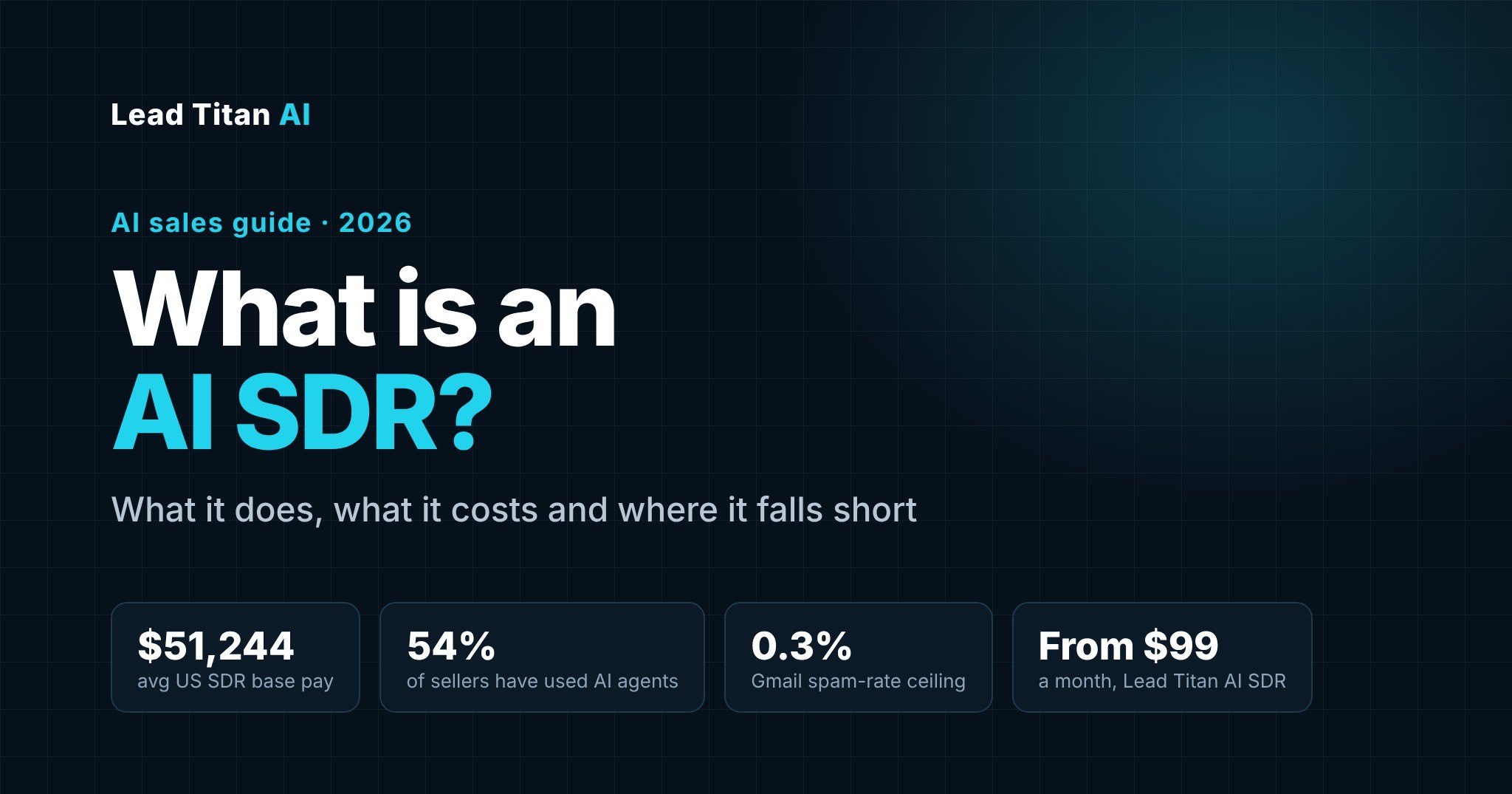
A human SDR in the US earns an average base salary of $51,244 a year, according to PayScale (2026). That's about $4,270 a month before commission, payroll taxes and tools.
AI SDR pricing varies a lot by vendor. Some charge per seat, some per contact, and some per meeting. For example, Lead Titan's AI SDR is an add-on for the Growth and Pro plans:
| Contacts per month | Price per month |
|---|---|
| 100 | $99 |
| 250 | $199 |
| 500 | $349 |
That doesn't make an AI SDR a full replacement for a person. It means the first-touch and follow-up work no longer has to wait until you can afford a hire.
Sources: PayScale: Sales Development Representative (SDR) Salary, Lead Titan pricing.
How common AI in sales has become
Salesforce's 2026 State of Sales report surveyed 4,050 sales professionals. It found 87% of sales organizations already use some form of AI, and 54% of sellers say they've used AI agents.
Using AI and getting results from it are different things, though. In Salesloft's 2026 Revenue Benchmark survey of 500 US sales and revenue decision-makers, only 20.6% described their AI strategy as production-ready with measurable outcomes.
Sources: Salesforce: State of Sales 2026, Salesloft: 2026 US Revenue Benchmark Report.
Where AI SDRs fall short
- Bad lists sink them. An AI SDR emails whatever list it's given. If a lot of those addresses bounce, your sending reputation takes the hit, and your future emails are more likely to land in spam.
- Generic copy still gets ignored. Tailoring an email to someone's job title isn't the same as saying something they care about. You still have to tell it what you sell and who it's for.
- It can't close. Complex objections, pricing negotiations and relationship work still need a person.
- Spam complaints add up. Google asks senders to keep their spam complaint rate below 0.1% and never reach 0.3%. Mass outreach to the wrong people makes that harder.
Source: Google: Email sender guidelines FAQ.
What to check before you turn one on
- Where do the leads come from, and when were their emails checked? An email checked months ago can be dead today.
- Whose inbox does it send from? Your own address means replies come to you.
- Can you read what it writes before or as it sends?
- What happens when someone replies with a hard question? It should hand off to you.
- How is it priced? Per seat, per contact or per meeting, and is there a contract?
How Lead Titan's AI SDR works
Lead Titan's AI SDR is built around the first point on that list: the quality of the leads it emails.
- Checked leads. Every Lead Titan lead it emails passed a mailbox check when you ordered it. Unconfirmed catch-all addresses and inboxes like info@ and sales@ are thrown out.
- Your inbox. It sends from your own Gmail or Outlook, so replies come to you.
- Replies and booking. It answers replies and books meetings on your Calendly.
- Handoffs. Hard negotiations get handed to you.
- Bad email? You don't pay. If an email sent from Lead Titan hard-bounces within 30 days, you don't pay for that lead.
Setup takes four steps: add your leads, tell it what you sell, link Calendly and turn it on. See the AI SDR page for a walkthrough of one lead from first email to booked meeting.
FAQ
What does SDR stand for?
Sales development representative: the person who finds and contacts new prospects and books meetings for the sales team.
Will an AI SDR replace my sales team?
No. It takes over repetitive outreach and follow-up. People still handle the meetings, the hard questions and the closing.
How much does an AI SDR cost?
It depends on the vendor. Lead Titan's AI SDR is $99 a month for 100 contacts, $199 for 250 and $349 for 500, as an add-on for Growth and Pro plans.
Can an AI SDR hurt my email deliverability?
Yes, if it emails bad addresses or the wrong people. Bounces and spam complaints hurt your sending reputation, so the list you give it matters as much as the tool.
Try it free
Start with about 25 verified leads a month, checked live when you order. No credit card.
Figures checked November 23, 2026. Salary data comes from PayScale and can change.